Five factors, not one score.
For students, it's a personal dashboard tracking progress across every session. For employers, it's a verified, evidence-rich talent record built from real conversations, not self-claims.
On top of the Conversational AI layer, the practice, assessment and coaching layer that runs across multiple languages (English, Hindi, Tamil, Telugu, Bengali, Gujarati, Marathi and more), sits the Behavioural Intelligence layer: decoding intent, motivational patterns and communication effectiveness.
Mentza's proprietary Career Readiness Score and Profile maps what the industry really cares about, beyond academic outcomes. The five factors below are derived from 16 different cognitive and behavioural markers, read from every conversation session a student has on Mentza. Every session drives improvement in these scores.
The Critical 5 Behavioural Factors
Anti-Fragility
Responds to pressure, setbacks & ambiguity: the most predictive factor for long-term performance.
Learnability
Speed & depth of absorbing new ideas, feedback & skills, critical in fast-changing roles.
Executive Presence
How one communicates, influences & commands attention, essential for leadership roles.
Agency
Ownership, initiative & self-direction: separates doers from waiters.
Career Vision
Clarity of purpose & direction: predicts motivation, retention & goal alignment.
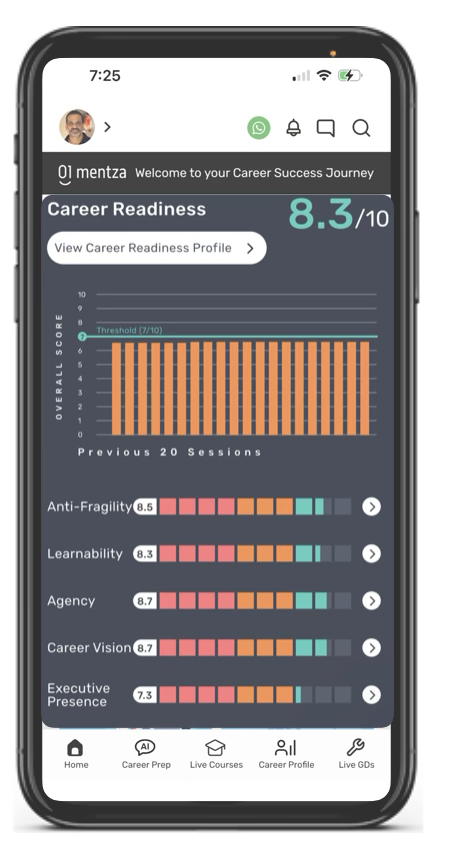
The Critical 5 Behavioural Factors: not what's written on a résumé, but how a person communicates, thinks, and adapts in real situations.
From The Career Readiness Report 2026 · 1 / 5
What 99 institutions taught us.
Mentza's inaugural annual benchmark, drawn from longitudinal conversational data across 99 higher education institutions, including the IITs, Delhi University, TAPMI and Kanpur University: thousands of student learning journeys, tens of thousands of AI-guided conversations, and hundreds of thousands of minutes of structured speaking practice.
Rather than treating employability as a single outcome, the report treats career readiness as a developmental process: one that can be measured, strengthened and continuously improved, using the same Behavioural Intelligence engine behind every Mentza conversation.
Key Observations · 2 / 5
Five findings that reshape how readiness is built.
From longitudinal data tracking the same students across repeated conversations, not a one-time snapshot.
Readiness improves with opportunity
Average Career Readiness Score rose more than 50% between early and later stages of engagement.
Behaviour develops in stages
Learnability improves first, then Career Vision, Agency and Anti-Fragility, with Executive Presence emerging last.
The earliest conversations matter most
Gains are largest in the first few sessions, then stabilise, a hallmark of behavioural learning curves.
A journey, not an event
Best measured longitudinally, across a student's whole time in higher education, not just at placement season.
Opportunity, not institution or starting talent, is the strongest driver of growth in the dataset.
The Evidence · 3 / 5
Growth was broad-based, not concentrated.
Behavioural improvement between Session 1 and Session 2, normalised for identical exposure to structured practice, across all 99 institutions.
Students starting in the bottom four-fifths of the cohort improved by roughly 2.5 to 3.0 CRS points, while the top 20% improved less, at 1.68 points: students with the most room to grow made the fastest gains, narrowing rather than widening the gap.
Five Principles · 4 / 5
What higher education should do differently.
Evidence-informed shifts in perspective, not prescriptive rules.
1. Developed, not discovered
Treat career readiness as developing throughout the student journey, not only at placement.
2. Build behaviour before performance
Confidence is an outcome of behavioural development, not a starting point taught in a workshop.
3. Create opportunity before evaluation
Students cannot demonstrate opportunities they were never given.
4. Measure growth, not just outcomes
The important measure is not where a student stands today, but how far they have progressed.
5. Embed it throughout, not just placement season
Career readiness should be a capability that grows with students throughout their time in higher education.
One Thousand Minutes · 5 / 5
Career readiness is not built in a single interview. It is built one conversation at a time.
"If students spend nearly seventy thousand minutes in formal education acquiring knowledge, could one thousand of those minutes, spent on deliberate conversational practice, meaningfully change their career readiness? That question became the starting point for Mentza."